
Good painting practice

We have two raw materials in painting: acrylic and oil.
Canvas are now mass produced and go from worst to best.
Endless binders and mediums is available on the market today. How to properly apply these materials without having to study 400 pages of information and history of painting?
Here are some simple precepts that ensure quality of your work and the longevity of your paintings.
Paintings and canvas 
- For chassis there is not much to do, they are now part of the fabric and one must satisfy with what has been produced. Check that the section of wooden pieces is sufficient relative to size. Keys must be present at inside corners of the frame. The fabric should be made of linen with a variable smoothness depending on your style. The cotton canvas lack of elasticity and are not strong enough, except for the price which is very low of course.
Oil or acrylic?
- If you are new to painting or if you do not like to wait for a slow drying, choose preferably acrylic. The weak point is a lack of body and dries quickly making it difficult to melt different colors on the canvas. Painting Mediums compensate these defects.
- Acrylic is ideal for not digging in the constraints of oil painting.
- If you choose the oil you use the better or the worse depending on your ability to implement it. A few simple rules:
- start working thinning with fresh turpentine. You can simply make a 'grisaille' (monochrome + white, usually brown or a neutral gray)
- gradually decrease the amount of thinner replacing it with a painting medium with quick drying characteristics. For that prepare a pure diluent vial, another with 50% medium and a last one 30% thinner, 30% medium and 30% polymerized linseed oil.
- This will avoid violating the rule : fatt on thin. It so avoid maximum sinkage (matt of the painted surface, the binding migrating down in depth ). Take care to let it dry between coats (minimum 1-2 weeks will do in most case ideally longer depending on the thickness of the applied layer).
- you end up with the pure oil paint and medium, avoiding the brilliant wax effect indicating an excess of medium or varnish.
- After a year you can apply varnish in 2 layers. Do not paint on old paintings already painted, even after sanding the surface.
Emulsion painting
- Nicolas Wacker (see bibliography) has left us the fruits of his research on a form of emulsion paint that dramatically reduces the mess of oil while keeping the beauty of its material. See also: bibliography.
Pastels and glue
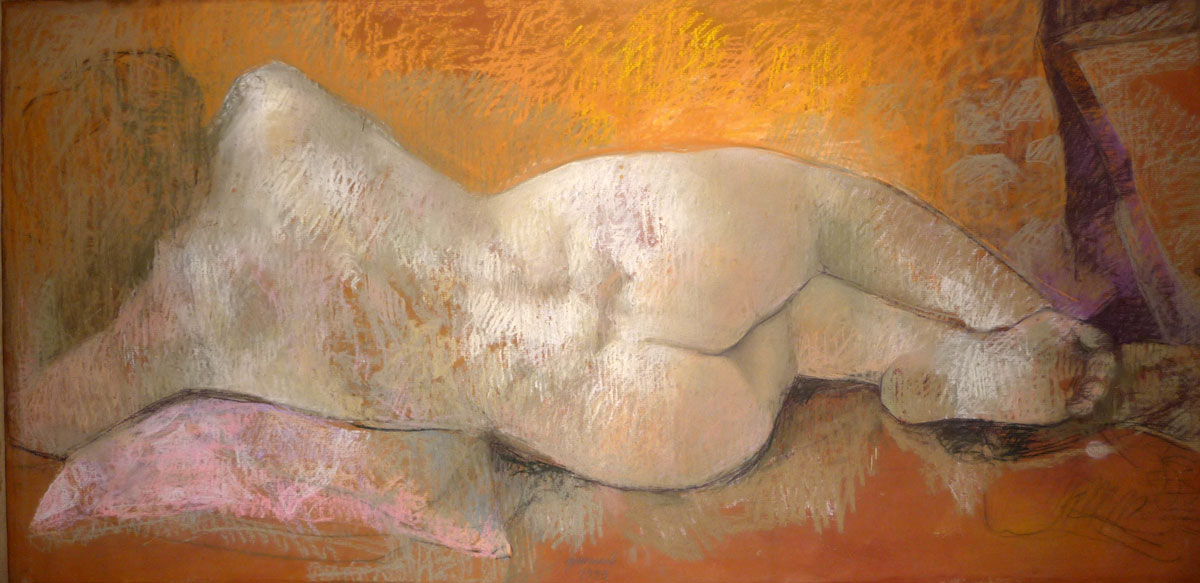
- Here is a technique that may please you a lot and provides an alternative to painting. You work on paper mounted (glued) on canvas or on a stand. To prepare this paper, the format is one or two inches inside the frame. With strips of kraft glued paper, you paste the sheet 4 sides on the support after having wet the paper with a sponge. Allow everything to dry overnight.
- With pastels you start working in fine layers, working with ds tips pastels held flat or hatching. Dip the brush in a mixture of 10-15% of white glue diluted with water. Work the pastel with this mixture without over saturating. Allow to dry. There also start with thin layers you épaissirez to as the work progresses.
- Take pastel with interventions brush and glue where necessary. If you dip the pastel lightly into the mixture of glue and water you get a crash and slurring. See Degas pastels that used this method.
These tips will get you started without too much trouble. For more information contact me or visit this page.
Il n’y a aucun produit à lister dans cette catégorie.